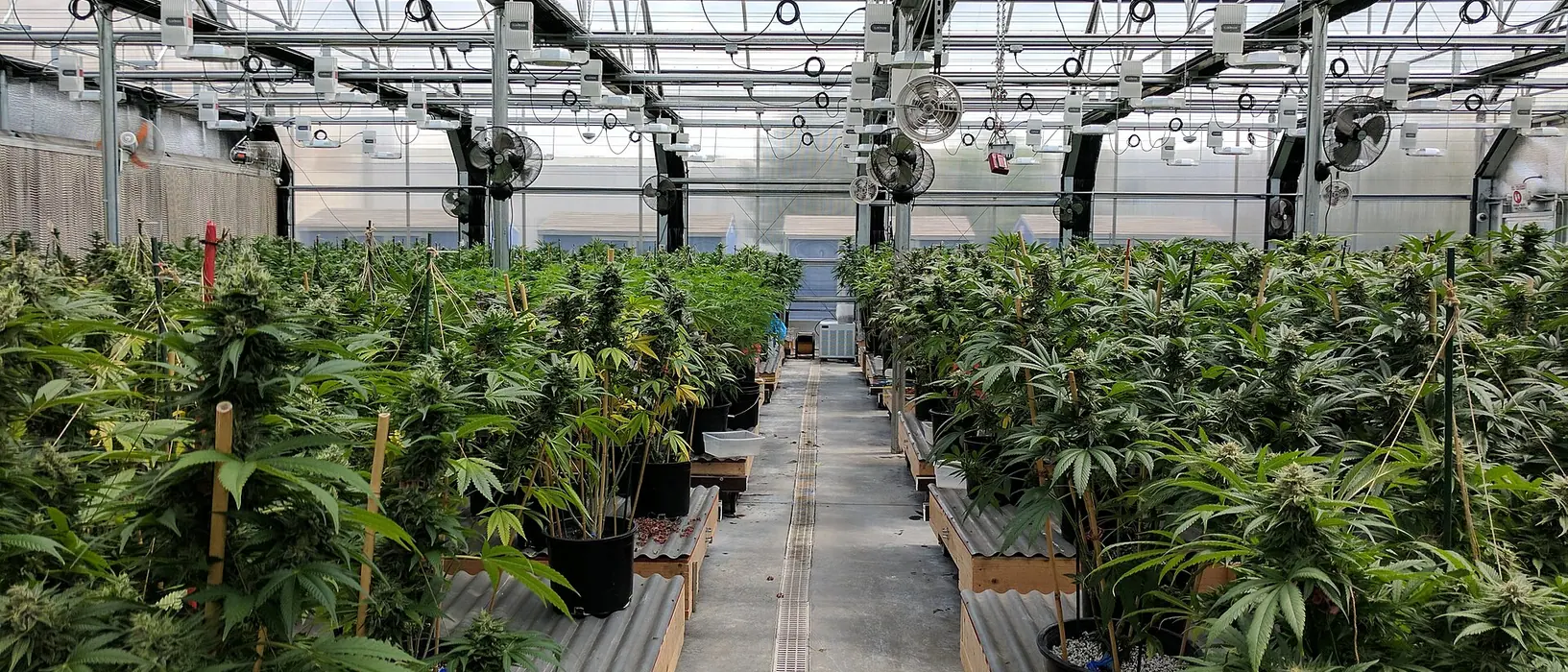
Medicinal cannabis greenhouses
We design and equip cultivation facilities for licensed medicinal and industrial cannabis only, in jurisdictions where cultivation is legal and the client holds a valid licence.
- Typical yield, cycles a year
- 5–6
Growing medicinal cannabis under glass
We undertake cannabis projects only where cultivation is legal and the client holds the required licence; proof of that licence is a precondition for our involvement. Within those limits, medicinal cannabis is a demanding horticultural crop. Buyers expect a standardised product with consistent active-compound content, so the facility has to deliver the same climate, light and hygiene in every room and in every cycle.
The plant flowers under short days, so production is steered by photoperiod: long days for vegetative growth, twelve hours of uninterrupted darkness for flowering. That requires blackout screens or enclosed rooms, high light levels and strong dehumidification, because dense flowers are vulnerable to Botrytis and mildew. Separate zones for mother plants, propagation, vegetative growth, flowering, drying and processing, with controlled access between them, complete the layout.
Depends on genetics, light level and the number of cycles a year, typically four to six; for medicinal use, consistent active-compound content matters more than weight.
Optimal greenhouse parameters
| Gutter height | 5–7 m for greenhouses; enclosed rooms are sized by design |
|---|---|
| Temperature, day / night | 24–28 °C / 18–22 °C |
| Relative humidity | 60–70% in vegetative growth; 45–55% in flowering |
| Light | Flowering typically 600–1,000 µmol/m²/s; 18 h days for growth, 12 h for flowering |
| Irrigation EC / pH | 1.5–3.0 mS/cm / 5.6–6.2 |
| Plant density | Set by plant-size strategy and bench layout; varies widely |
| CO2 level | 800–1,200 ppm |
Typical ranges, refined per variety and climate.
The configuration we recommend
A starting point. We adjust it to your site and budget.
Glass greenhouse with blackout, or enclosed rooms
Flowering needs twelve hours of complete darkness whatever the season.
High-intensity LED lighting
Flower yield rises with light level, and LED adds less heat that has to be removed.
Dehumidification and air handling
A dense flowering crop releases more moisture than vents can remove while blackout screens are closed.
Rolling benches or gutters with drip irrigation
Equal substrate volume and dosing per plant give a uniform batch.
Zoned layout with access control
Separating growth stages and processing supports hygiene, security and the quality system of the licence holder.
Solutions that matter most
What drives the business case
We build the financial model with your own prices and costs. These are the levers that move it most.
| Driver | What moves it |
|---|---|
| Licence and regulation | Permitted volume, product form and buyers are set by the licence, not by the grower |
| Yield per m² per year | Light level, genetics, cycle length and number of flowering cycles |
| Product quality | Consistent active-compound content and microbial limits decide whether a batch is accepted |
| Electricity cost | Lighting and dehumidification are the main loads; tariff and LED efficacy matter most |
| Compliance cost | Security, quality system, testing and documentation add fixed costs beyond horticulture |
Best practices
What our agronomists hold to in our own greenhouse and on client sites.
Work from uniform cuttings
Clonal plants from healthy, tested mother stock are the basis of a consistent batch.
Guard the dark period
Any light during the twelve-hour night can disturb flowering. Check screens, doors and indicator lamps.
Lower humidity as flowers fill
Reduce humidity through the flowering phase and keep air moving through the canopy to prevent Botrytis.
Keep pests out by design
Use filtered air, clothing changes and restricted access, and rely on scouting and beneficials.
Record every batch
Climate, irrigation and inputs are logged per batch to support the traceability that regulators require.
Questions we are asked
If yours is not here, write to us. An engineer replies within two working days.
In which countries do you take on cannabis projects?
Only in jurisdictions where cultivation of medicinal or industrial cannabis is legal, and only for clients who hold a valid licence from the competent authority. We do not take part in projects without that licence. Licensing itself is a matter between the client and the authority.
Greenhouse or indoor facility?
A greenhouse uses sunlight and has a lower energy cost; an enclosed facility gives the most constant conditions at a higher electricity use. Many medicinal producers choose glass greenhouses with blackout, lighting and air handling. The quality requirements of the target market often decide.
Does the facility have to meet pharmaceutical standards?
For medicinal products, regulators generally require cultivation under good agricultural and collection practice and processing under good manufacturing practice. Compliance is the responsibility of the licence holder. Our part is to design zoning, surfaces, air handling and data logging so that the client’s quality system can be implemented.
Plan your medicinal cannabis greenhouse
Tell us the country, the crop and the area. You get a confirmation at once and an engineer’s reply within two working days.
- Preliminary layout and budget range
- A visit to our 20-hectare reference greenhouse
- Support in English, Russian and Azerbaijani