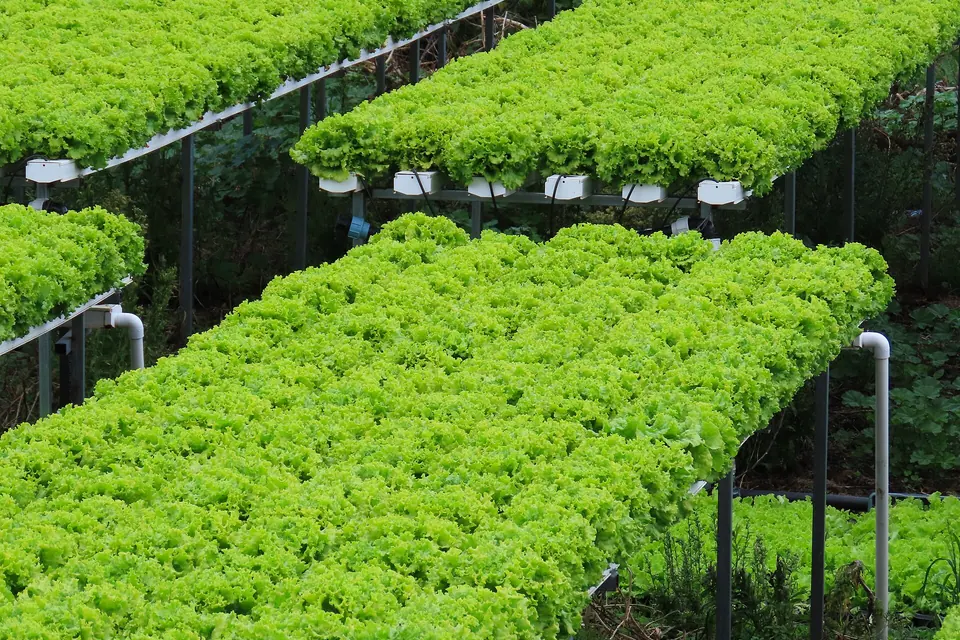
AE · United Arab Emirates Demo
3-hectare leafy greens facility, Abu Dhabi
- Crop
- Lettuce & herbs
- Area
- 3 ha
- Handover
- 2025
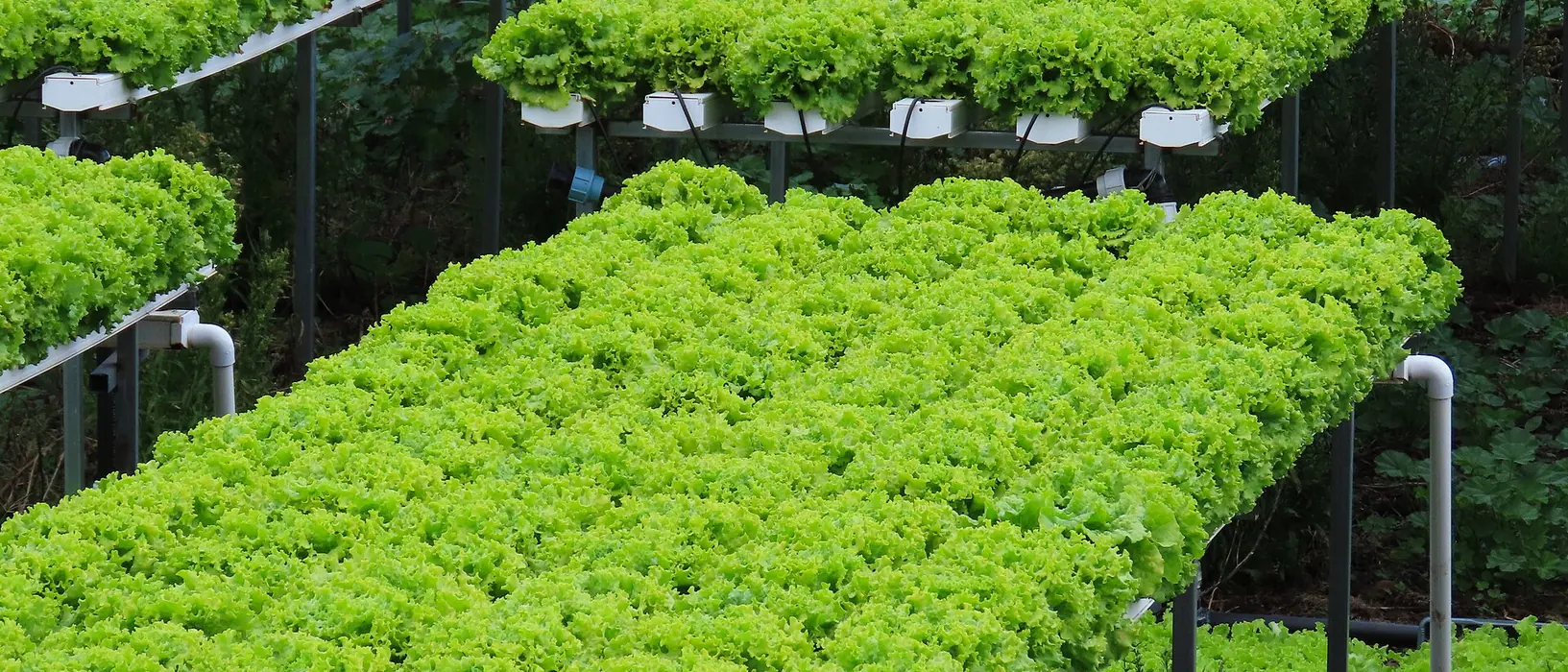
Lettuce and herbs are short-cycle crops in which output depends on spacing and logistics. We build greenhouses and growing systems that keep every square metre in production all year.
Lettuce and fresh herbs are grown in water, not in slabs. In a nutrient film system the plants stand in gullies that are moved apart as the heads grow; in deep-water culture they float on rafts across a pond. Both systems bring lettuce to harvest in roughly four to six weeks from transplanting, and the product leaves the greenhouse clean, with or without its roots.
Because the cycle is short, the business depends on rhythm: sowing, transplanting, spacing and harvesting on every working day of the year. The greenhouse is therefore designed around the logistics line as much as around climate. Even light, moderate temperature, cool roots and steady air movement over the heads matter most, since tipburn and bolting are the main quality risks in warm or humid weather.
Depends on target head weight, daily light integral, spacing strategy and number of cycles; herbs are planned per pot or per cut.
| Gutter height | 4.5–6 m |
|---|---|
| Temperature, day / night | 16–22 °C / 12–16 °C for lettuce; basil needs warmer air |
| Relative humidity | 60–80% |
| Daily light integral | 12–17 mol/m² per day for lettuce |
| Nutrient solution EC / pH | 1.2–2.2 mS/cm / 5.5–6.2 |
| Plant density | 14–25 heads per m² at final spacing |
| CO2 level | 600–1,000 ppm |
Typical ranges, refined per variety and climate.
A starting point. We adjust it to your site and budget.
Lettuce needs uniform light more than height, so the choice of structure follows climate and lighting.
Automatic spacing uses the area fully, and ponds buffer root temperature in hot climates.
A constant daily light integral gives a constant cycle length and head weight.
Air movement over the heart of the plant keeps calcium moving and prevents tipburn.
Cool, oxygen-rich, clean solution protects against Pythium and root loss.
We build the financial model with your own prices and costs. These are the levers that move it most.
| Driver | What moves it |
|---|---|
| Output per m² | Spacing automation, light sum, cycle length and target head weight |
| Sales price | Living lettuce, cut heads or processed leaf; retail contracts and year-round supply |
| Energy cost per head | Lighting hours in winter; cooling of air and solution in summer |
| Labour cost per head | Degree of automation in sowing, transplanting, spacing and harvest |
| Seed and young-plant cost | Many cycles a year make seed, plugs and propagation space a significant cost line |
What our agronomists hold to in our own greenhouse and on client sites.
Shade above the target and light below it. A steady light sum gives uniform heads and predictable harvest dates.
Keep air moving over the crop, avoid very high humidity at night and do not push growth faster than calcium can follow.
Hold the solution at roughly 18–22 °C with high dissolved oxygen, especially in summer.
Widen the gullies or move the rafts before leaves overlap. Late spacing costs weight and invites mildew.
Downy mildew races shift quickly, so variety resistance is reviewed every season.
AE · United Arab Emirates Demo
Only Baku Greenhouse Complex is a real project. The others are samples that show the layout and will be replaced with real references.
If yours is not here, write to us. An engineer replies within two working days.
Mobile gullies give the best use of area and suit automation and living lettuce sold with roots. Deep-water ponds are simpler, buffer temperature and nutrition, and tolerate a pump failure. Hot climates and large volumes of cut lettuce often favour ponds; retail living lettuce favours gullies.
Yes, with cooling of both air and nutrient solution, shading and heat-tolerant varieties. Root temperature is often the deciding factor, which is why solution cooling is standard in hot regions. Night temperature determines how well quality holds in midsummer.
Basil, coriander, parsley, mint, dill and rocket are all grown hydroponically. Potted herbs are usually raised on ebb-and-flood benches, cut herbs in gullies or ponds. Basil needs warmer air than lettuce, so it is best given its own climate compartment.
Tell us the country, the crop and the area. You get a confirmation at once and an engineer’s reply within two working days.
Nothing found. Try another word or write to us.