Hydroponic & substrate systems
We supply the complete root-zone system: gutters, substrate, drip lines, drain collection and crop support, matched to the crop and to the quality of your water.
- of irrigation water typically returns as drain and can be reused
- 20–35%
- Technology partners
- Grodan, Pelemix, Meteor Systems
What it is
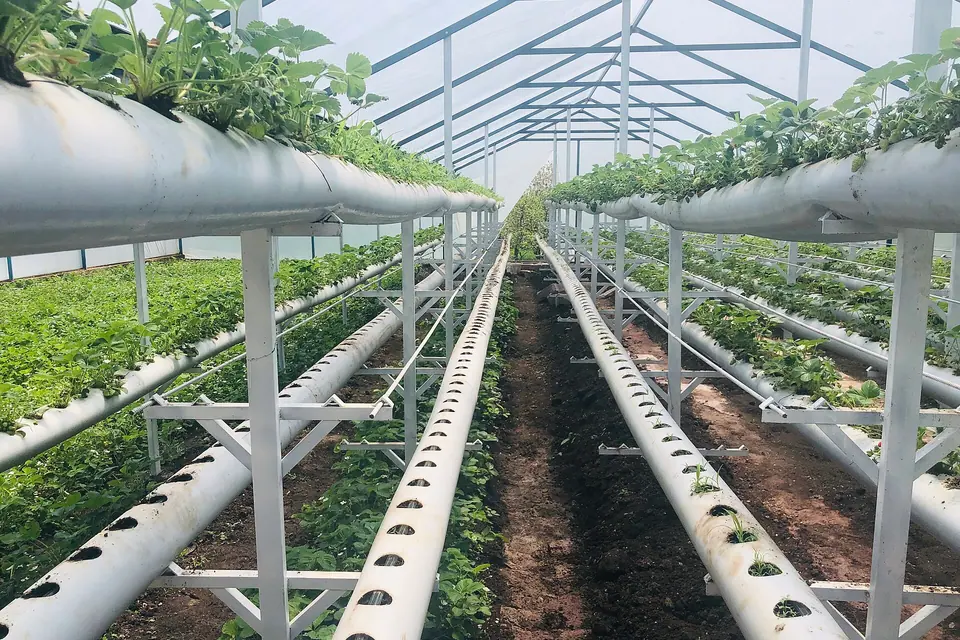
Growing in substrate gives the grower direct control over water, nutrition and root temperature, and it separates the crop from soil-borne disease and salinity. In a modern greenhouse the plants stand in stone wool or coco slabs on hanging gutters. The drain water runs back along the gutter to a collection point, where it can be measured, disinfected and reused.
The choice of substrate and gutter is an agronomic decision before it is a purchasing one. Stone wool is uniform and quick to steer; coco holds more air and forgives irrigation errors; nutrient film and floating rafts suit short-cycle leafy crops. We specify slab volume, gutter slope and dripper layout together with the irrigation unit, because the root zone only works as one system.
What it includes
- Growing gutters
- Hanging or ground-supported steel gutters, often roll-formed on site in one length per row, with a fixed slope towards the drain collector.
- Substrate
- Stone wool or coco slabs, blocks and plugs, selected by water-holding capacity and the length of the crop cycle.
- Drip layout
- Pressure-compensated drippers with one stake per plant or block, so that every plant receives the same volume.
- Drain collection
- Drain pipes, pits and pumps that return gutter drain to the irrigation room for disinfection and reuse.
- Crop support
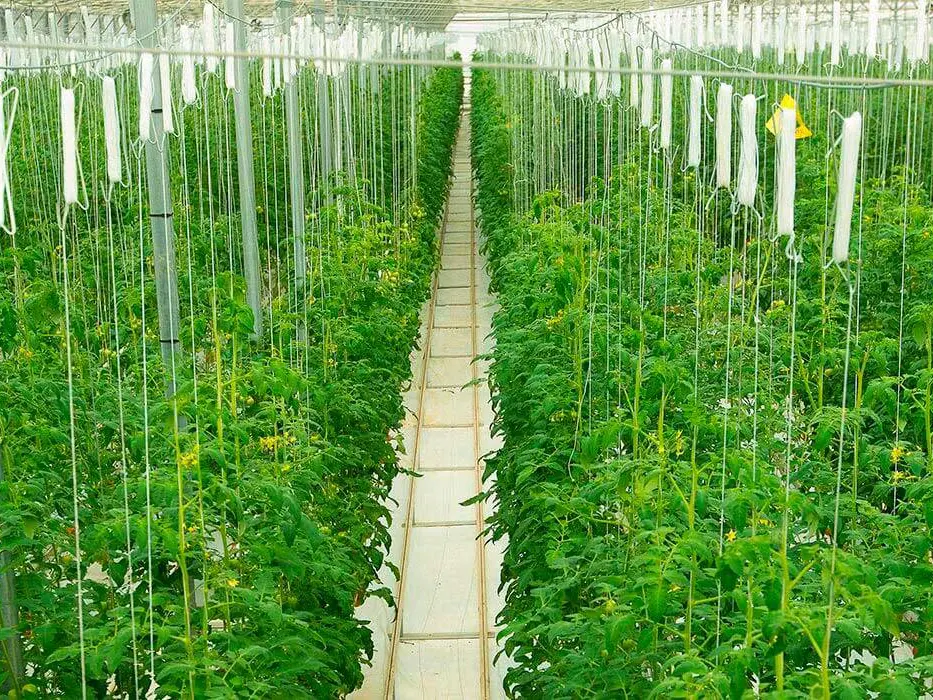
- Crop wire, high-wire hooks, clips and truss supports sized for the plant load of the crop.
- Root-zone measurement
- Slab scales or sensors for water content, EC and temperature, linked to the irrigation strategy.
Options and configurations
The choice follows the crop, the climate and the size of the investment.
Stone wool on hanging gutters
An inert, uniform substrate with a precise steering range for water content and EC. It rewards growers who work with slab measurements and a defined irrigation strategy.
Best suited toLong-cycle tomato, cucumber and pepper
Coco in slabs or containers
Coco coir buffers water and holds more air, which makes it tolerant of heat and of interruptions in irrigation. It is supplied as slabs, grow bags or loose fill for buckets.
Best suited toHot climates, berries, and teams new to hydroponics
NFT and mobile gullies
Plants grow in channels with a thin film of recirculating nutrient solution. Moving the gullies apart as the crop grows raises output per square metre.
Best suited toLettuce, herbs and other short-cycle leafy crops
Deep-water culture
Rafts float on a pond of aerated nutrient solution, which gives a large buffer for temperature and nutrition.
Best suited toLettuce and leafy greens, especially in hot climates
Technical specifications
Typical ranges for high-tech greenhouses. The exact figures for your project are calculated at the design stage.
| Gutter row spacing | Typically 1.60 m centre to centre for high-wire vegetables |
|---|---|
| Gutter slope | Typically 1–3 mm per metre towards the drain end |
| Stone wool slab | Typically 100 × 15–20 × 7.5–10 cm |
| Substrate volume | Typically 8–14 litres per m² of greenhouse |
| Slab water content | Steered between about 50% and 80%, depending on crop phase |
| Drain percentage | Typically 20–35% of the daily irrigation volume |
| Substrate life | Stone wool usually one crop cycle; coco one to three, depending on crop and hygiene |
What you gain
Control of the root zone
Water content, EC and pH are set by the grower and can be corrected within hours.
Water and fertiliser reuse
Drain collected in the gutters returns to the mixing tank, which typically saves 20–30% of water and fertiliser against free drainage.
A clean start every cycle
New or disinfected substrate separates each crop from the diseases and salts left by the previous one.
Better working height
Hanging gutters bring crop work and harvest to a comfortable height and keep the floor free for trolleys.
A uniform crop
Equal slab volume and dripper output per plant give an even crop that is easier to manage and to forecast.
Projects using this solution
All projectsOnly Baku Greenhouse Complex is a real project. The others are samples that show the layout and will be replaced with real references.
Questions we are asked
If yours is not here, write to us. An engineer replies within two working days.
Is stone wool or coco the better substrate?
Neither is better in general. Stone wool is uniform and responds quickly to steering, which rewards an experienced team with good measurements; coco buffers more water and air and tolerates heat and small errors. We advise on the basis of crop, climate, water quality and the experience of your growers.
What water quality does hydroponics need?
Low sodium, chloride and bicarbonate are the main requirements, because these build up when drain is recirculated. A full water analysis is the first document we ask for. Where the source is saline, reverse osmosis or rainwater collection is added to the design.
What happens to used substrate?
Stone wool is typically replaced after one long crop; coco can often be used for more than one season if the crop stayed healthy. Used coco can be composted or worked into open land. Stone wool needs a recycling or disposal route, which should be checked locally before the substrate is chosen.
Can we grow in soil first and convert later?
It is possible, but the greenhouse should then be designed for gutters from the start: column heights, drain pits and irrigation capacity are hard to change afterwards. In most climates the yield and water savings of substrate growing are a strong argument for building it in from the first crop.
Get a quote for hydroponic & substrate systems
Tell us the country, the crop and the area. You get a confirmation at once and an engineer’s reply within two working days.
- Preliminary layout and budget range
- A visit to our 20-hectare reference greenhouse
- Support in English, Russian and Azerbaijani