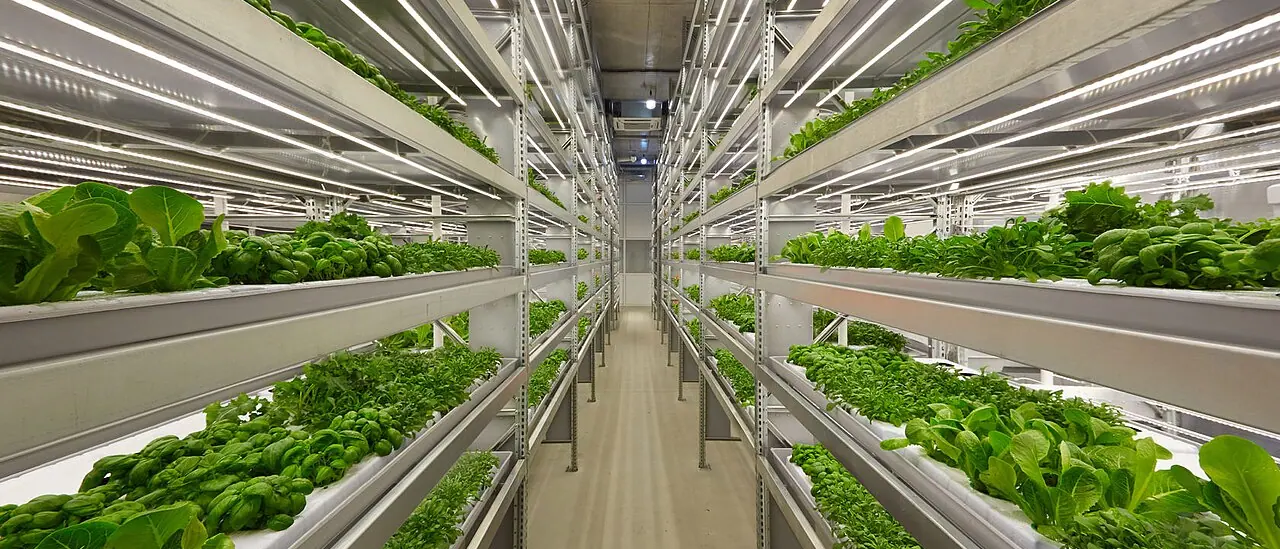
Indoor & vertical farming greenhouses
Vertical farms grow leafy crops in stacked layers under LED light, independent of the weather. We assess where the model makes economic sense and supply the growing and climate systems.
- Typical yield, less water
- up to 95%
Growing indoor & vertical farming under glass
A vertical farm replaces the sun with LEDs and the greenhouse with an insulated building. Plants grow in stacked layers, each with its own light and irrigation, while an air-handling system removes lamp heat and the moisture the crop transpires. Because every input is controlled, production is the same in January and in July, uses very little water and can be located close to the consumer.
The limits are economic. All light is paid for as electricity, so the model suits compact, fast, high-value crops: lettuce, baby leaf, herbs, microgreens and young plants. It is most convincing where summers are extreme, water is scarce, land is expensive or fresh produce is flown in. We compare a vertical farm side by side with a lit or cooled greenhouse for the same crop before recommending either.
Per layer the output is close to that of a well-lit greenhouse; the gain per m² of floor comes from stacking, and depends on light level, head weight and cycle length.
Optimal greenhouse parameters
| Building and layers | Insulated hall; typically 40–60 cm per layer for leafy crops |
|---|---|
| Temperature, lights on / off | 20–24 °C / 17–20 °C |
| Relative humidity | 60–75% |
| Light | Typically 150–300 µmol/m²/s for 16–18 h a day, from LED only |
| Nutrient solution EC / pH | 1.2–2.2 mS/cm / 5.5–6.2 |
| Plant density | Lettuce typically 20–35 heads per m² of layer; baby leaf and microgreens are sown densely |
| CO2 level | 800–1,200 ppm |
Typical ranges, refined per variety and climate.
The configuration we recommend
A starting point. We adjust it to your site and budget.
Insulated, airtight building
A closed envelope keeps the climate constant and pests out, and makes CO2 enrichment efficient.
Multi-layer racks with NFT or ebb-and-flood
Shallow recirculating systems keep the weight and water volume per layer low.
Dimmable LED with a crop-specific spectrum
Light is the main input cost, so efficacy and uniformity come first.
Air handling with dehumidification
Removing lamp heat and transpired moisture is the largest climate task, and the condensate is reused.
Mechanised tray handling
Sowing, moving and harvesting by machine keeps labour per head low and the room clean.
Solutions that matter most
What drives the business case
We build the financial model with your own prices and costs. These are the levers that move it most.
| Driver | What moves it |
|---|---|
| Electricity cost per kg | Tariff, LED efficacy, light level and the efficiency of cooling and dehumidification |
| Output per m² of floor | Number of layers, cycle length and space lost to aisles and equipment |
| Sales price | Premium for local, clean, year-round product against imported or field-grown leaf |
| Capital cost | Building, racks, LEDs, air handling and automation cost more per m² than a greenhouse |
| Labour and automation | Manual handling in tall racks is slow; automation raises investment and cuts cost per head |
Best practices
What our agronomists hold to in our own greenhouse and on client sites.
Design airflow per layer
Uniform air speed across every shelf prevents tipburn and pockets of humid air.
Match light to crop stage
Use lower intensity for germination and young plants, and full intensity only when the canopy can use it.
Choose compact, fast varieties
Short cycles and a high share of saleable leaf make the best use of paid light.
Keep the room clean
Filtered air, clean seed and substrate, and entry hygiene avoid the need for crop protection treatments.
Track electricity per kilogram
Measure kWh per kilogram harvested in every cycle. It is the figure that decides the margin.
Questions we are asked
If yours is not here, write to us. An engineer replies within two working days.
Is a vertical farm better than a greenhouse?
Not in general: a greenhouse uses sunlight and costs less to build and to run per kilogram for most crops. A vertical farm can win where the climate is extreme, water or land is scarce, or the market pays for local leafy produce all year. We calculate both for the same site.
Which crops are suitable?
Lettuce, baby leaf, herbs, microgreens and young plants for transplanting. Fruiting crops such as tomato need far more light per kilogram and are rarely economic under LED light alone. Strawberry is a partial exception in some markets.
How much water does it save?
Water use per kilogram is very low because the room is closed: irrigation recirculates, and the moisture the plants transpire is condensed by the air-handling units and reused. Most of the water that leaves the farm leaves inside the product.
Plan your indoor & vertical farming greenhouse
Tell us the country, the crop and the area. You get a confirmation at once and an engineer’s reply within two working days.
- Preliminary layout and budget range
- A visit to our 20-hectare reference greenhouse
- Support in English, Russian and Azerbaijani