Packaging & post-harvest
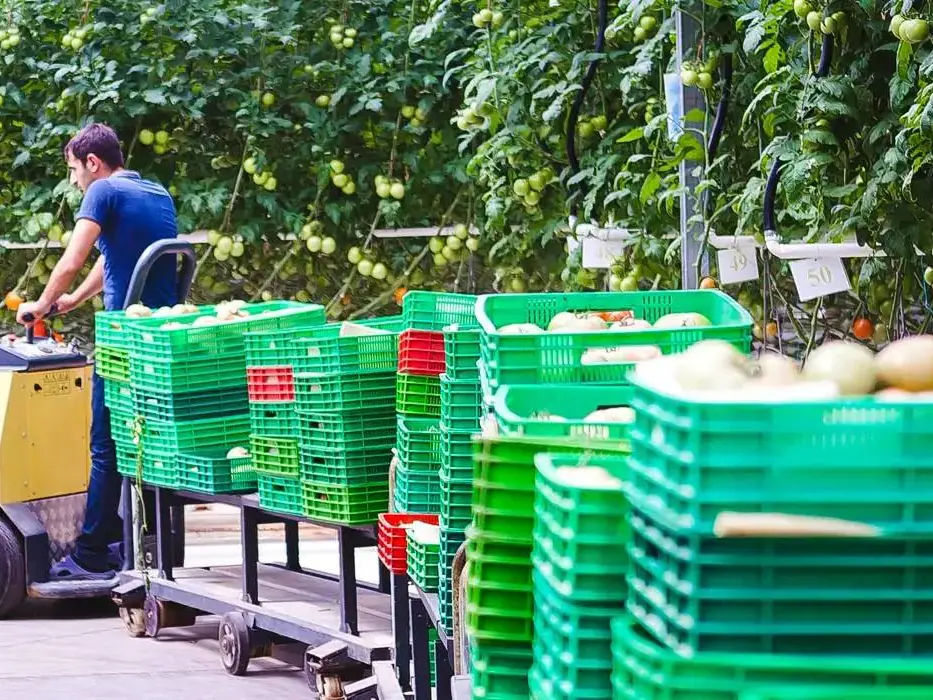
We plan and equip the post-harvest chain: harvest trolleys, internal transport, grading and packing lines, cold storage and dispatch, sized for the peak harvest week.
- typical cold-store set point for tomato and cucumber
- 10–13 °C
- Technology partners
- Bogaerts
What it is
Product quality is fixed at harvest; everything afterwards can only preserve it. The time between the plant and the cold store, the number of times a fruit is handled and the temperature at which it travels decide shelf life and the share sold as class I. A packing hall therefore has to be designed together with the greenhouse, not attached to it later.
We size the hall on the peak week of the crop plan and on what the buyer orders: loose in cartons, on the vine, flow-packed or in punnets. Harvest trolleys and transport routes connect the rows to the grading line, and cold rooms hold each product at its own set point. Trading of produce is one of the group’s service lines, so the sales channel is part of the design discussion from the start.
What it includes
- Harvest logistics
- Pipe-rail trolleys, harvest carts and towed or automated transport from the path to the hall.
- Grading and sorting
- Lines that sort by weight, size and colour, from simple weighing tables to optical graders.
- Packing equipment
- Carton erectors, flow-pack, punnet filling and top-seal machines, with weighing and labelling.
- Cooling
- Pre-cooling and cold rooms with temperature and humidity control per product group.
- Traceability
- Lot labels that tie each pallet to a greenhouse block and a harvest date.
- Hall layout
- Separate flows for product, packaging material, waste and staff, with docks for refrigerated trucks.
Options and configurations
The choice follows the crop, the climate and the size of the investment.
Bulk packing hall
Weighing, manual or semi-automatic grading, and packing in cartons or crates. Investment is low and the hall stays flexible.
Best suited toWholesale and regional markets
Retail packing line
Automated grading with flow-pack, punnet or top-seal units, check-weighing and labelling.
Best suited toSupermarket supply with fixed pack weights
Cold chain for export
Pre-cooling, cold storage and refrigerated docks that hold the product at set point until it is loaded.
Best suited toLong-distance road and air freight; berries and flowers
Automated internal transport
Harvest trolleys on guided or automated routes, with a buffer in front of the grading line.
Best suited toLarger sites where labour is scarce or costly
Technical specifications
Typical ranges for high-tech greenhouses. The exact figures for your project are calculated at the design stage.
| Tomato and cucumber storage | Typically 10–13 °C; lower temperatures risk chilling injury |
|---|---|
| Sweet pepper storage | Typically 7–10 °C |
| Lettuce and leafy greens | Typically 1–4 °C; basil is kept warmer, at around 12 °C |
| Strawberry | Typically 0–2 °C, cooled within hours of picking |
| Cut roses | Typically 2–4 °C after hydration |
| Cold-room humidity | Typically 85–95% for vegetables |
| Hall capacity | Sized on peak-week harvest volume and the number of packing formats |
What you gain
A higher class I share
Fewer handling steps and fast cooling reduce bruising, softening and weight loss.
Longer shelf life
An unbroken cold chain from hall to truck adds days for transport and sale.
Labour productivity
Ergonomic trolleys and organised transport cut the walking time that makes up a large part of harvest labour.
Traceable product
Lot coding supports the audits retail buyers require and narrows any recall to a block and a date.
Formats that match the buyer
The line is specified around the packs your customers order, with room to add formats later.
Projects using this solution
All projectsOnly Baku Greenhouse Complex is a real project. The others are samples that show the layout and will be replaced with real references.
Questions we are asked
If yours is not here, write to us. An engineer replies within two working days.
How large should the packing hall be?
It follows from the peak-week volume, the number of packing formats and how long product stays on site, all of which come from the crop plan. Building the hall shell for the final phase and equipping it in steps is usually cheaper than extending it later.
Do we need automated grading from the first day?
Not always. A first phase that sells loose product to wholesale can start with weighing and manual grading. Retail contracts with fixed pack weights and colour specifications are what justify optical graders and packing machines.
Can different crops share one cold store?
Only within limits. Tomato and cucumber store at similar temperatures, but leafy greens and berries need conditions close to zero, and ethylene from ripening tomatoes damages cucumbers and flowers. Mixed sites need separate rooms.
Does Grow Group help to sell the produce?
Trading of produce is one of the group’s service lines. Whether and how it applies to a project abroad depends on the product, the volumes and the destination market, and it is agreed case by case.
Get a quote for packaging & post-harvest
Tell us the country, the crop and the area. You get a confirmation at once and an engineer’s reply within two working days.
- Preliminary layout and budget range
- A visit to our 20-hectare reference greenhouse
- Support in English, Russian and Azerbaijani