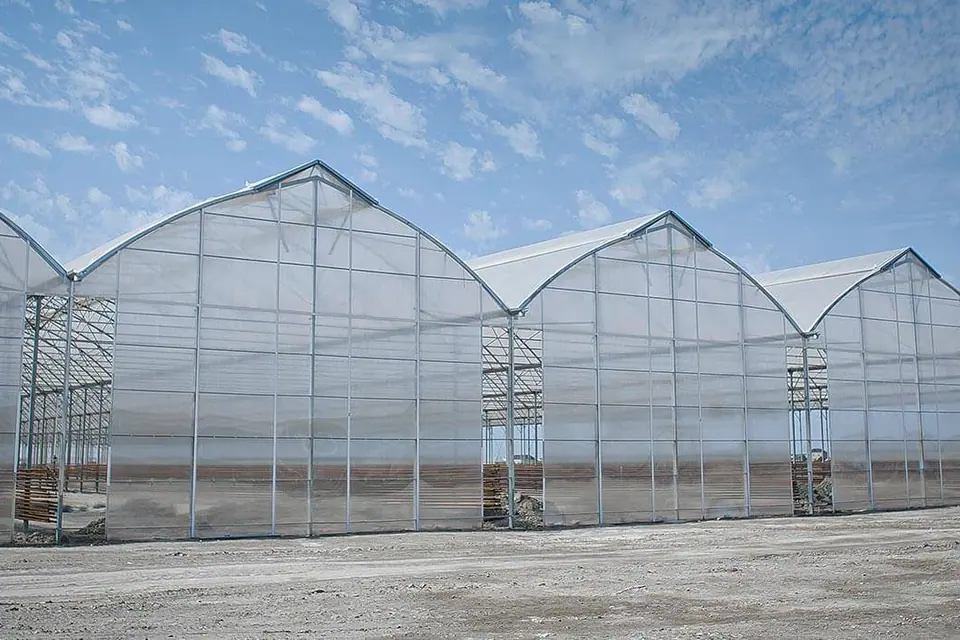
Cooling & heating systems
We calculate cooling and heating from local climate records and supply the complete installation: pad walls, fans, fogging, roof coatings, boilers, buffer tanks and pipe networks.
- typical air temperature drop with pad-and-fan in dry climates
- 8–12 °C
- Technology partners
- Mardenkro, Priva, Richel Group
What it is
The markets we serve run from winter nights of −30 °C on the Kazakh steppe to summer afternoons above 45 °C in the Gulf. One design cannot serve both. We size heating on the coldest design night and cooling on the hottest, driest afternoon, then check the seasons in between, because humidity control in spring and autumn often decides crop health.
Evaporative cooling works where the air is dry: a pad-and-fan wall typically lowers incoming air by 8–12 °C in arid climates and far less on humid coasts. Heating is delivered as hot water through steel pipes that also serve as rails for trolleys. Both are run by the climate computer, so cooling, heating and ventilation do not work against each other.
What it includes
- Evaporative pad walls
- Cellulose pads with water distribution, sump and bleed-off, installed along one gable or a climate corridor.
- Fans
- Exhaust or pressure fans selected for air volume and static pressure, with staged or variable-speed control.
- High-pressure fog
- Stainless nozzle lines above the crop that add cooling and humidity without wetting the leaves.
- Roof shading
- Seasonal coatings and movable shade screens that cut the heat radiation entering the greenhouse.
- Heating network
- Pipe-rail, growth-pipe and, where needed, overhead circuits, each with its own mixing valve.
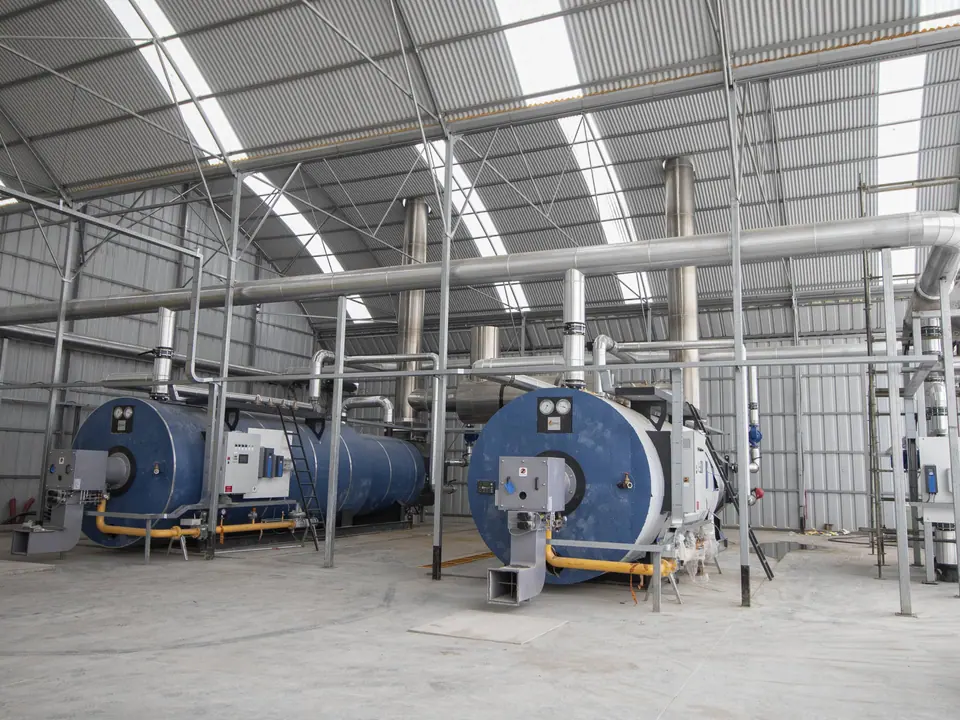
- Boiler house
- Hot-water boilers with flue-gas condenser, heat buffer tank, expansion system and transport pumps.
Options and configurations
The choice follows the crop, the climate and the size of the investment.
Pad-and-fan
Fans draw outside air through wet pads along one wall. The method is simple and effective where the air is dry; its water consumption belongs in the water balance.
Best suited toArid and continental summers in Central Asia and the Middle East
High-pressure fog with roof ventilation
Fine mist evaporates above the crop while the vents remove humid air. It cools evenly over long greenhouses and raises humidity in dry heat.
Best suited toLarge Venlo blocks, propagation, and dry winter air under lighting
Roof shading
Reflective or diffusing coatings on the roof, combined with movable shade screens, reduce the heat load before it has to be removed.
Best suited toRegions with strong summer radiation; pepper, leafy greens and flowers
Hot-water heating with buffer
Boiler or CHP heat is stored in an insulated tank and released to the pipe circuits on demand.
Best suited toAny climate with a heating season, and all winter production
Technical specifications
Typical ranges for high-tech greenhouses. The exact figures for your project are calculated at the design stage.
| Pad-and-fan cooling | Air typically 8–12 °C cooler in dry climates; less at high humidity |
|---|---|
| Pad-to-fan distance | Typically up to 40–50 m before the temperature gradient becomes too large |
| High-pressure fog | Typically 70–100 bar, with droplets of around 10 µm |
| Heating capacity | Typically 150–350 W/m², set by the design outside temperature |
| Pipe-rail heating | 51 mm steel pipe; supply water typically up to 80–90 °C |
| Heat buffer | Typically 100–250 m³ per hectare |
| Shading coating | Applied in spring and removed in autumn; type chosen per crop and climate |
What you gain
Production through the summer
Cooling maintains fruit set and quality in months when an uncooled greenhouse would under-produce or stand empty.
A winter crop in cold regions
Heating capacity and buffer are sized to carry the crop through design-temperature nights.
Heat where the plant needs it
Separate pipe-rail and growth-pipe circuits put heat at the root zone, the ripening fruit or the growing tip as required.
Lower peak loads
Shading coatings and screens reduce the heat load before fans and pads have to remove it.
Humidity under control
Heating, venting and fog are coordinated to hold a humidity deficit in which the crop can transpire.
Projects using this solution
All projects
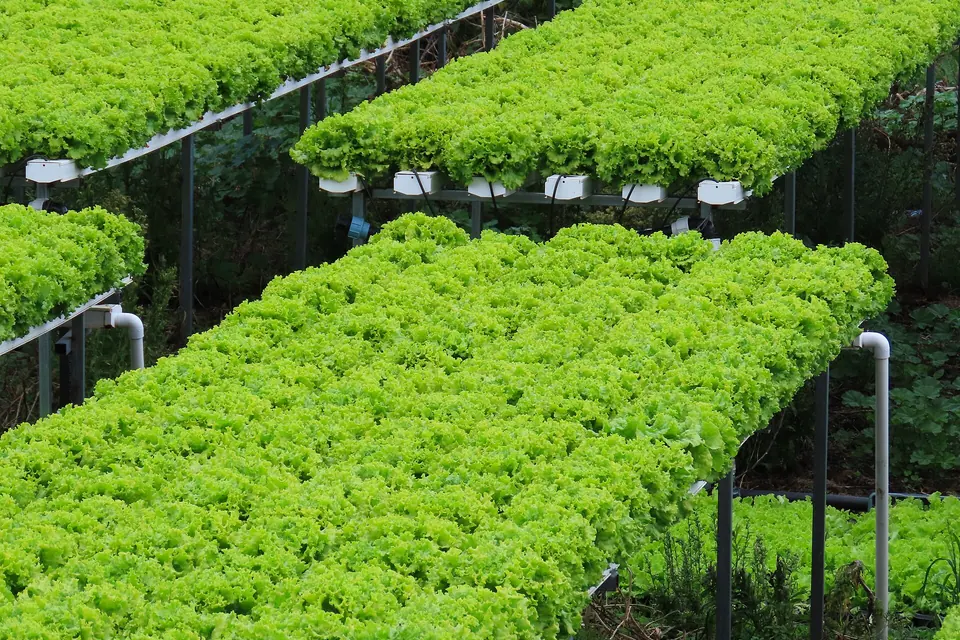
AE · United Arab Emirates Demo
3-hectare leafy greens facility, Abu Dhabi
- Crop
- Lettuce & herbs
- Area
- 3 ha
- Handover
- 2025
Only Baku Greenhouse Complex is a real project. The others are samples that show the layout and will be replaced with real references.
Questions we are asked
If yours is not here, write to us. An engineer replies within two working days.
Does pad-and-fan cooling work in humid climates?
Only partly. Evaporative cooling depends on the gap between dry-bulb and wet-bulb temperature, so on a humid coast the drop may be only a few degrees. In such locations we combine high ventilation capacity, shading and screens, and assess semi-closed concepts case by case.
How much water does evaporative cooling use?
On a hot, dry day a pad wall can evaporate several litres per square metre of greenhouse, on top of irrigation. This has to be included in the water balance of the project. The pad circuit also needs bleed-off and reasonable water quality to prevent scaling.
Which heating fuel should the project use?
Natural gas is the usual choice where a connection exists, because cleaned flue gas can also supply CO2 to the crop. Without gas, the options are solid-fuel or biomass boilers, heat pumps, and geothermal or industrial waste heat. We compare them on local tariffs and security of supply.
Can a greenhouse operate at −30 °C?
Yes: high-tech greenhouses produce through winters of that order in Russia and Kazakhstan. The design adds heating capacity, double energy screens, backup boilers and standby power. Energy cost per kilogram is the figure to test in the business plan.
Get a quote for cooling & heating systems
Tell us the country, the crop and the area. You get a confirmation at once and an engineer’s reply within two working days.
- Preliminary layout and budget range
- A visit to our 20-hectare reference greenhouse
- Support in English, Russian and Azerbaijani