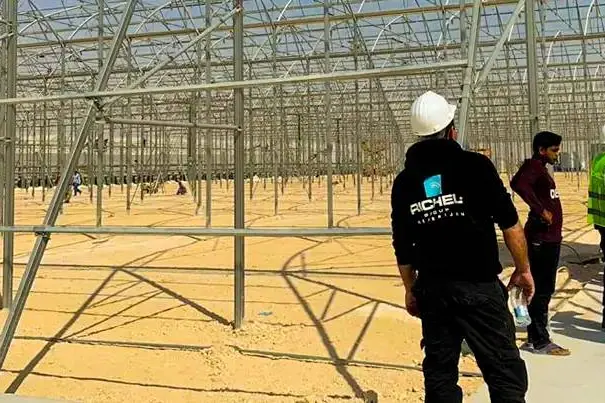
Investors often ask how soon a greenhouse can be producing. The honest answer for a high-tech project of 5–10 hectares is typically 12–16 months from feasibility study to first harvest. Shorter is possible on a prepared site with fast permitting. Longer is common when utilities or financing are not settled at the start. This article follows the eight stages we use in our own projects.
The schedule at a glance
The months below are typical ranges, counted from the start of the feasibility study. Stages overlap: equipment is ordered while drawings are being finished, and installations begin before the last glass is laid.
| Stage | Typical months | What is decided or delivered |
|---|---|---|
| 1. Feasibility and site assessment | 0–1 | Whether site, climate, water and energy support the business case |
| 2. Concept design and budget | 1–2 | Greenhouse type, layout, technical specification, budget |
| 3. Detailed engineering and permits | 2–4 | Construction drawings and permit documentation |
| 4. Procurement and logistics | 3–7 | Manufacturing, shipping and customs |
| 5. Civil works and structure | 5–9 | Foundations, steel, covering |
| 6. Technical installations | 8–12 | Heating, irrigation, climate control, electrical systems |
| 7. Commissioning and training | 11–13 | Tested systems and a trained team |
| 8. First crop, harvest and handover | 12–16 | Planting, first harvest, formal handover |
Months 0–4: decisions on paper
The cheapest months of a project are the ones that decide most of its cost. In the feasibility study we collect long-term climate data, a water analysis, a soil survey and the terms of the gas and electricity connections. From these come the greenhouse type, the heating and cooling concept and a first budget.
Detailed engineering turns the concept into drawings that a contractor can build from and an authority can approve. Permitting is the least predictable part of this phase, because it depends on local procedure and not on engineering. We prepare the documentation; the client or a locally licensed designer usually submits it.
What the client can do early
- Secure the land title and the access road.
- Apply for gas, electricity and water connections. Utility lead times are often longer than construction itself.
- Appoint one person with the authority to make decisions.
Months 3–12: from orders to a closed building
Steel, glass, screens, boilers and climate computers are made to order. Manufacturing and transport together typically take three to five months, so orders are placed as soon as the specification is frozen. A change to the specification after this point is one of the most common causes of delay.
On site, earthworks and foundations come first, followed by the steel structure, gutters and covering. In continental climates concrete work is planned for the frost-free season. Once the building is weather-tight, installation teams work in parallel on heating pipes, irrigation, screens, electrical cabling and the growing system.
Months 11–16: commissioning and first crop
Commissioning is more than switching systems on. Each one is tested alone and then together: does the climate computer open the vents, close the screens and start the boilers in the right order? Operators and growers are trained on the systems they will run.
Young plants are ordered from a propagator weeks in advance, so the planting date has to be fixed while construction is still under way. For tomato, the first harvest typically follows eight to ten weeks after planting; cucumber is faster. Our agronomists stay with the crop through the first cycle, and formal handover follows once the systems have performed under a real crop.
What delays projects
- Utilities. A greenhouse without its gas or grid connection cannot be commissioned.
- Late changes. A new crop or layout after ordering resets manufacturing lead times.
- Season. A structure that is not closed before winter may have to wait for spring.
- Financing milestones. Orders cannot be placed until payments are released.
A realistic schedule is built backwards from the planting date, not forwards from the contract date.
If you are planning a project, send us the location, the area and the crop. We will tell you which of these stages is likely to set the pace on your site.